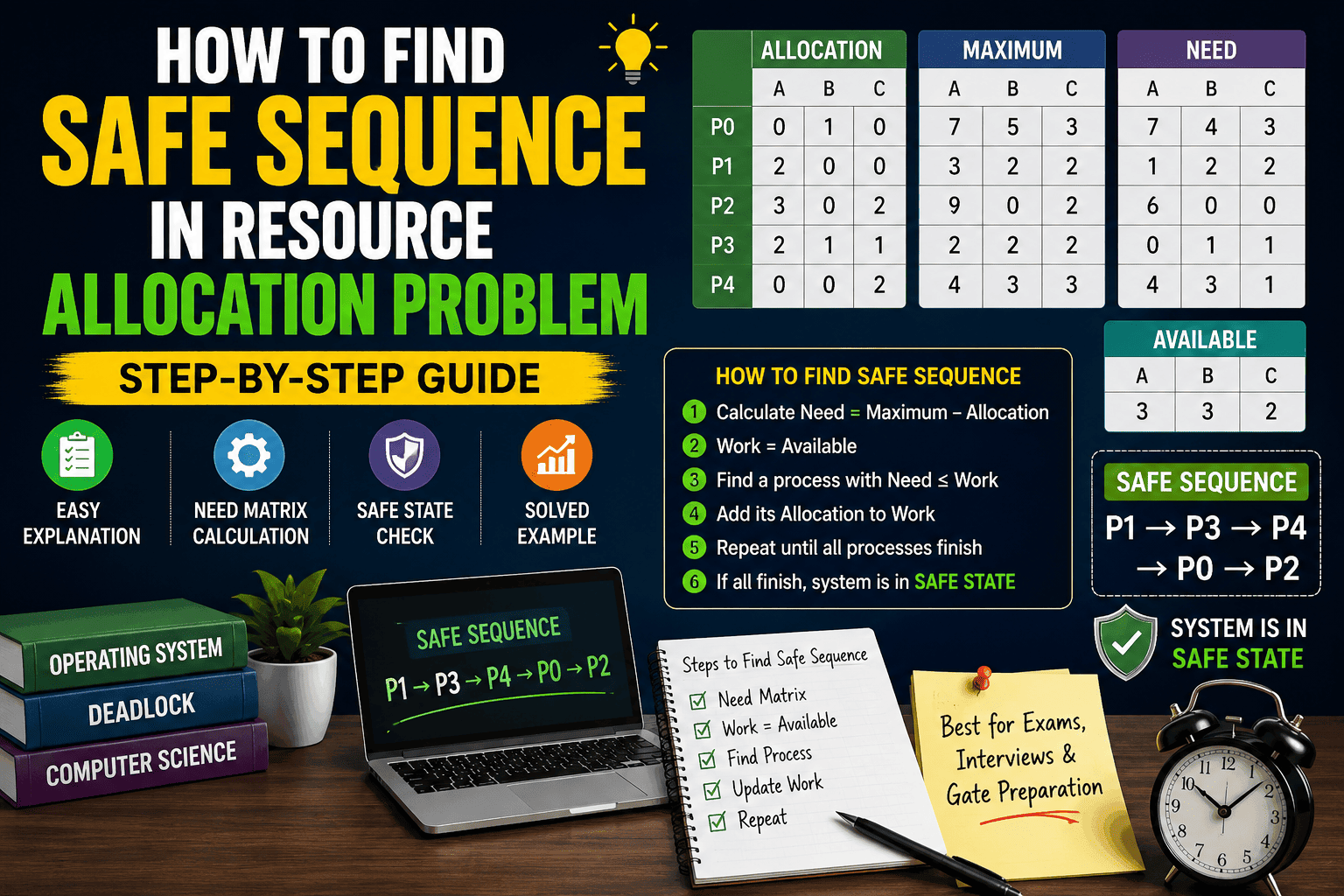
Finding a safe sequence in a resource allocation problem is an important concept in Operating Systems, especially when studying deadlock avoidance and resource management. Many students understand the basic idea of deadlock but find it difficult to calculate a safe sequence from an Allocation, Maximum, and Available resource matrix.
In this guide, we will learn how to find safe sequence in resource allocation problem step by step using a simple numerical example. We will also understand the Need Matrix, Work vector, Finish vector, and how to determine whether a system is in a safe state.
What Is a Safe Sequence?
A safe sequence is an ordered list of processes in which every process can complete successfully with the resources currently available in the system.
In simple words, a system is considered safe when there is at least one possible order in which all processes can finish without causing a deadlock.
For example, suppose a system has five processes:
P0, P1, P2, P3, and P4.
If the processes can complete in the order:
P1 → P3 → P4 → P0 → P2
then this order is called a safe sequence, provided each process receives the resources it needs and can complete successfully.
The important point is that a system may have multiple safe sequences. Finding just one valid sequence is enough to prove that the system is in a safe state.
Why Do We Need to Find a Safe Sequence?
Operating systems manage limited resources such as CPU-related resources, memory, files, I/O devices, and other system resources. When multiple processes request these resources simultaneously, improper allocation can result in deadlock.
A safe sequence helps the operating system determine whether granting resources can lead to a safe state.
If at least one safe sequence exists, the system is in a safe state.
If no process can satisfy its remaining resource requirement with the currently available resources, the system is unsafe.
An unsafe state does not always mean that deadlock has already occurred, but it means the operating system cannot guarantee that all processes will complete without a deadlock.
Data Required to Find a Safe Sequence
To solve a resource allocation problem, we normally need three important matrices or vectors:
1. Allocation Matrix
The Allocation Matrix tells us how many resources are currently allocated to each process.
For example:
| Process | A | B | C |
|---|---|---|---|
| P0 | 0 | 1 | 0 |
| P1 | 2 | 0 | 0 |
| P2 | 3 | 0 | 2 |
| P3 | 2 | 1 | 1 |
| P4 | 0 | 0 | 2 |
2. Maximum Matrix
The Maximum Matrix represents the maximum number of resources that each process may need during its execution.
| Process | A | B | C |
|---|---|---|---|
| P0 | 7 | 5 | 3 |
| P1 | 3 | 2 | 2 |
| P2 | 9 | 0 | 2 |
| P3 | 2 | 2 | 2 |
| P4 | 4 | 3 | 3 |
3. Available Vector
The Available vector shows the number of resources that are currently available.
For our example:
Available = (3, 3, 2)
Before finding the safe sequence, we need to calculate one more important matrix called the Need Matrix.
How to Calculate the Need Matrix
The Need Matrix represents the additional resources required by each process to complete its execution.
The formula is:
Need = Maximum − Allocation
We subtract the corresponding Allocation value from the Maximum value.
For P0:
Maximum = (7, 5, 3)
Allocation = (0, 1, 0)
Therefore:
Need(P0) = (7−0, 5−1, 3−0)
Need(P0) = (7, 4, 3)
Similarly, we calculate the Need for every process.
The complete Need Matrix becomes:
| Process | A | B | C |
|---|---|---|---|
| P0 | 7 | 4 | 3 |
| P1 | 1 | 2 | 2 |
| P2 | 6 | 0 | 0 |
| P3 | 0 | 1 | 1 |
| P4 | 4 | 3 | 1 |
This matrix is the key to finding the safe sequence.
How to Find Safe Sequence in Resource Allocation Problem
Now let’s solve the problem step by step.
Initially:
Work = Available = (3, 3, 2)
We compare the Need of each process with Work.
The rule is simple:
Need[i] ≤ Work
This means every resource requirement of the selected process must be less than or equal to the currently available resources.
If the condition is satisfied, that process can finish.
After the process finishes, it releases all the resources that were allocated to it.
The new Work value is:
Work = Work + Allocation
Let’s apply this rule.
Step 1: Check P0
Need of P0 = (7, 4, 3)
Work = (3, 3, 2)
Compare:
7 > 3
Therefore, P0 cannot finish at this stage.
We move to the next process.
Step 2: Check P1
Need of P1 = (1, 2, 2)
Work = (3, 3, 2)
Compare each resource:
1 ≤ 3
2 ≤ 3
2 ≤ 2
All conditions are satisfied.
Therefore, P1 can finish.
The current safe sequence is:
P1
After P1 completes, it releases its allocated resources.
Allocation of P1 = (2, 0, 0)
New Work:
(3, 3, 2) + (2, 0, 0)
= (5, 3, 2)
Step 3: Check P2
Need of P2 = (6, 0, 0)
Current Work = (5, 3, 2)
Compare:
6 > 5
Therefore, P2 cannot finish yet.
Move to P3.
Step 4: Check P3
Need of P3 = (0, 1, 1)
Work = (5, 3, 2)
Compare:
0 ≤ 5
1 ≤ 3
1 ≤ 2
All conditions are satisfied.
Therefore, P3 can finish.
Safe sequence:
P1 → P3
Allocation of P3 = (2, 1, 1)
New Work:
(5, 3, 2) + (2, 1, 1)
= (7, 4, 3)
Step 5: Check P4
Need of P4 = (4, 3, 1)
Work = (7, 4, 3)
All requirements are satisfied:
4 ≤ 7
3 ≤ 4
1 ≤ 3
Therefore, P4 can finish.
Safe sequence:
P1 → P3 → P4
Allocation of P4 = (0, 0, 2)
New Work:
(7, 4, 3) + (0, 0, 2)
= (7, 4, 5)
Step 6: Check P0 Again
Need of P0 = (7, 4, 3)
Work = (7, 4, 5)
All requirements are satisfied.
Therefore, P0 can finish.
Safe sequence:
P1 → P3 → P4 → P0
Allocation of P0 = (0, 1, 0)
New Work:
(7, 4, 5) + (0, 1, 0)
= (7, 5, 5)
Step 7: Check P2
Need of P2 = (6, 0, 0)
Work = (7, 5, 5)
All requirements are satisfied.
Therefore, P2 can finish.
The final safe sequence is:
P1 → P3 → P4 → P0 → P2
Since every process can successfully complete, the system is in a safe state.
Safe Sequence Calculation Shortcut
When solving examination questions, you can use the following procedure:
- Calculate the Need Matrix using Maximum − Allocation.
- Set Work equal to Available.
- Find a process whose Need is less than or equal to Work.
- Mark that process as completed.
- Add its Allocation to Work.
- Repeat the process for the remaining processes.
- If every process is completed, the system has a safe sequence.
- If no unfinished process can satisfy Need ≤ Work, the system is unsafe.
This method is especially useful for solving numerical questions quickly during university exams, placement tests, and competitive examinations.
Safe State vs Unsafe State
A safe state means that the operating system can find at least one sequence in which all processes can complete.
An unsafe state means that no valid completion sequence can currently be guaranteed.
For example, if:
Work = (2, 1, 1)
and every unfinished process requires more resources than Work, no process can proceed. In that situation, a safe sequence cannot be generated.
It is important to remember that unsafe state and deadlock are not exactly the same thing. An unsafe state indicates that the system has entered a condition where deadlock may occur. Deadlock means processes are actually stuck waiting for resources in a circular or otherwise unresolvable manner.
Common Mistakes While Finding Safe Sequence
Students often make a few mistakes when solving resource allocation problems.
Mistake 1: Using Maximum Instead of Need
The safe sequence calculation does not directly compare Maximum with Available. You need to calculate:
Need = Maximum − Allocation
Then compare Need with Work.
Mistake 2: Forgetting to Add Allocation
After a process completes, its allocated resources become available again.
Therefore:
New Work = Old Work + Allocation
Forgetting this step can produce an incorrect result.
Mistake 3: Checking Only One Process
If P0 cannot finish, that does not mean the system is unsafe.
You should check P1, P2, P3, and so on. Another process may be able to complete and release resources.
Mistake 4: Stopping After Finding One Process
Finding the first process is only the beginning. You must continue until all processes are completed.
Mistake 5: Treating Unsafe State as Immediate Deadlock
An unsafe state means the system cannot guarantee a safe completion order. It does not necessarily mean that deadlock has already happened.
Frequently Asked Questions
What is the formula for finding Need Matrix?
The formula is:
Need = Maximum − Allocation
The calculation is performed for every process and every resource type.
What is a safe sequence?
A safe sequence is an order of processes in which every process can obtain its remaining required resources, complete execution, and release its allocated resources so that the next process can proceed.
How do you know if a resource allocation problem is safe?
Calculate the Need Matrix and repeatedly compare each unfinished process’s Need with the current Work vector. If all processes can finish, the system is safe.
Can a system have more than one safe sequence?
Yes. A resource allocation problem can have multiple valid safe sequences. You only need to find one valid sequence to prove that the system is in a safe state.
What happens if no process satisfies Need ≤ Work?
If none of the unfinished processes can satisfy the condition, a safe sequence cannot be completed from the current state. The system is therefore considered unsafe.
Conclusion
Learning how to find safe sequence in resource allocation problem becomes much easier once the calculation is divided into simple steps. First calculate the Need Matrix, then set Work equal to Available resources. Find a process whose remaining requirement can be satisfied, allow it to complete, add its Allocation back to Work, and repeat the process.
In our example, the final safe sequence was:
P1 → P3 → P4 → P0 → P2
Because every process was able to complete, the system was in a safe state.
For Operating System exams, the most important things to remember are the Need = Maximum − Allocation formula, the Need ≤ Work condition, and the rule Work = Work + Allocation after a process finishes. Once these three ideas are clear, most safe-sequence numerical problems become straightforward to solve.