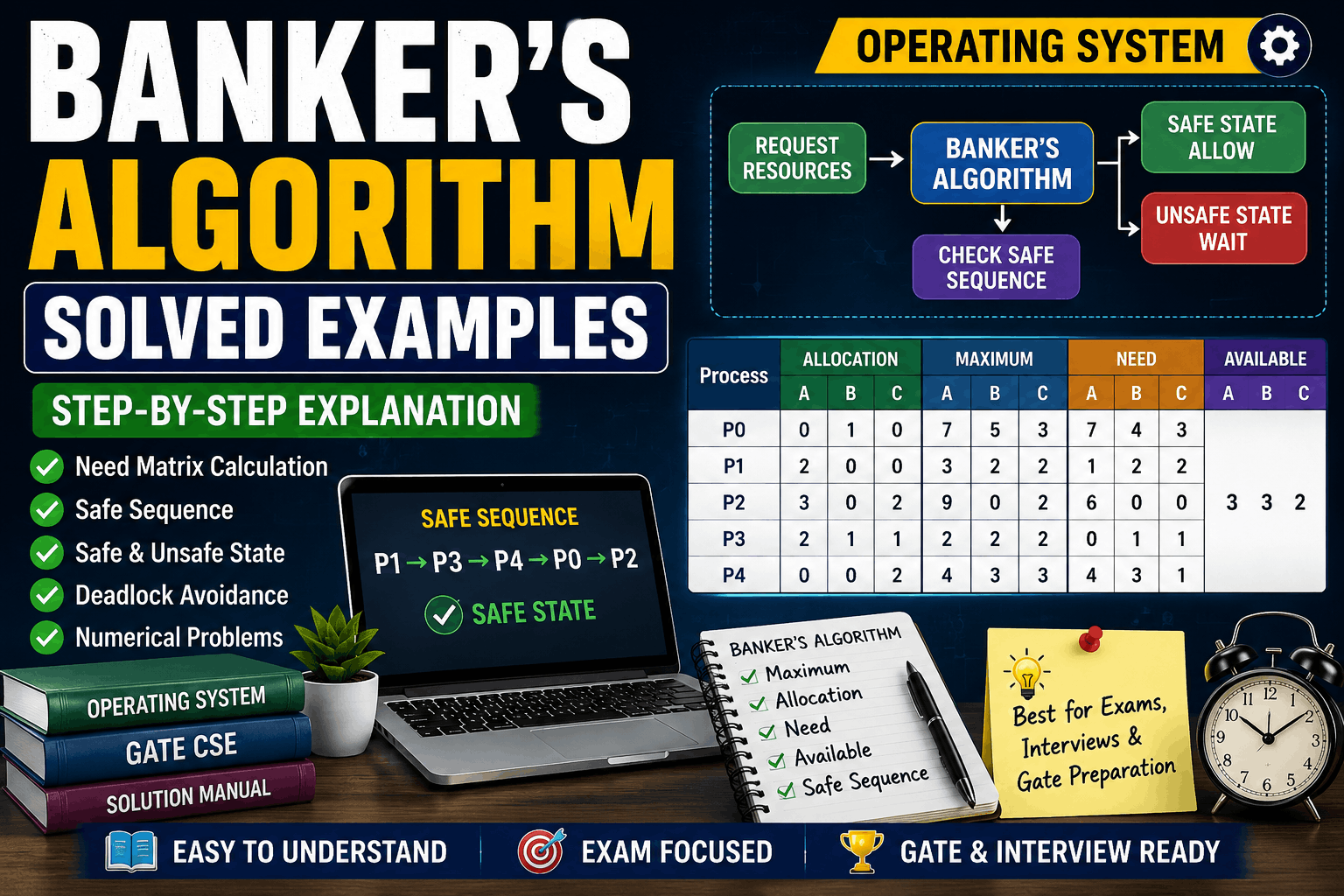
The Banker’s Algorithm is one of the most important concepts in Operating System, especially for students preparing for university exams, technical interviews, and GATE CSE. It is mainly used for deadlock avoidance by checking whether allocating resources to processes can keep the system in a safe state.
Many students understand the basic definition but struggle when they see a numerical problem involving Available, Allocation, Maximum, Need, Work, and Safe Sequence.
This guide explains Banker’s Algorithm solved examples step by step so that you can understand how to calculate the Need Matrix, identify a safe sequence, and determine whether a system is safe or unsafe.
What Is Banker’s Algorithm?
Banker’s Algorithm is a deadlock avoidance algorithm used by an operating system to decide whether resource allocation can be safely performed.
The basic idea is simple: before giving resources to a process, the system checks whether the resulting state can still allow all processes to finish successfully.
If at least one safe sequence exists, the system is considered to be in a safe state.
If no such sequence can be found, the state is considered unsafe.
An unsafe state does not automatically mean that deadlock has already occurred. It means the system cannot guarantee that all processes will finish without potentially entering deadlock.
For more background, you can also study our related Operating System topics, including deadlock, CPU scheduling, and Operating System interview questions.
Important Data Structures in Banker’s Algorithm
Before solving a numerical problem, understand these four terms.
1. Available
The Available vector represents the number of currently free resources for each resource type.
For example:
Available = [3, 3, 2]
This means:
- Resource A = 3
- Resource B = 3
- Resource C = 2
2. Maximum
The Maximum matrix shows the maximum number of resources that each process may require during its execution.
3. Allocation
The Allocation matrix represents the resources currently allocated to each process.
4. Need
The Need matrix represents the additional resources required by each process to complete its execution.
The formula is:
Need = Maximum − Allocation
This formula is one of the most important formulas in Banker’s Algorithm numerical problems.
Banker’s Algorithm Solved Example
Let us consider a system containing five processes:
P0, P1, P2, P3 and P4
There are three resource types:
A, B and C
Suppose the current system state is:
| Process | Allocation A B C | Maximum A B C |
|---|---|---|
| P0 | 0 1 0 | 7 5 3 |
| P1 | 2 0 0 | 3 2 2 |
| P2 | 3 0 2 | 9 0 2 |
| P3 | 2 1 1 | 2 2 2 |
| P4 | 0 0 2 | 4 3 3 |
The currently available resources are:
Available = [3, 3, 2]
Our goal is to determine whether the system is in a safe state and, if it is, find the safe sequence.
Step 1: Calculate the Need Matrix
Use:
Need = Maximum − Allocation
For P0:
Need(P0) = [7,5,3] − [0,1,0]
Therefore:
Need(P0) = [7,4,3]
For P1:
Need(P1) = [3,2,2] − [2,0,0]
Therefore:
Need(P1) = [1,2,2]
For P2:
Need(P2) = [9,0,2] − [3,0,2]
Therefore:
Need(P2) = [6,0,0]
For P3:
Need(P3) = [2,2,2] − [2,1,1]
Therefore:
Need(P3) = [0,1,1]
For P4:
Need(P4) = [4,3,3] − [0,0,2]
Therefore:
Need(P4) = [4,3,1]
The complete Need Matrix is:
| Process | Need A B C |
|---|---|
| P0 | 7 4 3 |
| P1 | 1 2 2 |
| P2 | 6 0 0 |
| P3 | 0 1 1 |
| P4 | 4 3 1 |
Step 2: Compare Need With Available
Initially:
Work = Available = [3, 3, 2]
Now we search for a process whose entire Need is less than or equal to Work.
Check P0
P0 needs:
[7,4,3]
Available:
[3,3,2]
Since 7 > 3, P0 cannot finish at this point.
Check P1
P1 needs:
[1,2,2]
Available:
[3,3,2]
All requirements can be satisfied.
Therefore, P1 can finish.
After P1 finishes, it releases its allocated resources:
Work = Work + Allocation(P1)
Work = [3,3,2] + [2,0,0]
Work = [5,3,2]
So our first process in the safe sequence is:
P1
Step 3: Check the Remaining Processes
Now:
Work = [5,3,2]
Check P3
P3 needs:
[0,1,1]
This is less than or equal to:
[5,3,2]
Therefore, P3 can finish.
After releasing its allocation:
Work = [5,3,2] + [2,1,1]
Work = [7,4,3]
Safe sequence so far:
P1 → P3
Check P4
P4 needs:
[4,3,1]
Current Work:
[7,4,3]
P4 can finish because all its requirements can be satisfied.
After P4 releases its resources:
Work = [7,4,3] + [0,0,2]
Work = [7,4,5]
Safe sequence:
P1 → P3 → P4
Check P0
P0 needs:
[7,4,3]
Current Work:
[7,4,5]
P0 can now finish.
After releasing its allocated resources:
Work = [7,4,5] + [0,1,0]
Work = [7,5,5]
Safe sequence:
P1 → P3 → P4 → P0
Check P2
P2 needs:
[6,0,0]
Current Work:
[7,5,5]
P2 can also finish.
Therefore:
Work = [7,5,5] + [3,0,2]
Work = [10,5,7]
The final safe sequence is:
P1 → P3 → P4 → P0 → P2
Since every process can finish, the system is in a:
SAFE STATE
What Is a Safe Sequence?
A safe sequence is an order in which every process can receive the resources it needs, complete execution, and then release its allocated resources for other processes.
In our example:
P1 → P3 → P4 → P0 → P2
is one valid safe sequence.
It is important to understand that there can be more than one valid safe sequence. The existence of at least one complete safe sequence is enough to establish that the current state is safe.
Banker’s Algorithm: Safety Algorithm Steps
For exam and interview preparation, remember these steps:
- Set Work = Available.
- Set Finish[i] = False for every process.
- Find a process whose Need[i] ≤ Work.
- If such a process exists, assume that it completes.
- Update Work using:
Work = Work + Allocation[i]
- Set Finish[i] = True.
- Repeat the process for the remaining processes.
- If every process becomes finished, the system is safe.
- If some processes cannot finish, the state is unsafe.
The most common mistake students make is comparing Allocation with Available instead of comparing Need with Available or Work.
Safe State vs Unsafe State
| Safe State | Unsafe State |
|---|---|
| At least one safe sequence exists | No complete safe sequence can be found |
| All processes can potentially finish | System cannot guarantee completion of all processes |
| Resource allocation can proceed safely | A resource request may need to be delayed |
| Deadlock can be avoided | Deadlock may become possible |
For a deeper understanding of deadlock concepts, refer to a reliable Operating System reference such as GeeksforGeeks’ Banker’s Algorithm guide.
Banker’s Algorithm vs Deadlock Detection
Banker’s Algorithm is used for deadlock avoidance, not simply for detecting an already existing deadlock.
The algorithm continuously evaluates whether resource allocation can keep the system in a safe state.
Deadlock detection, on the other hand, attempts to determine whether processes have already reached a deadlocked condition.
This distinction is frequently asked in Operating System exams and interviews.
You can also connect this topic with your other Operating System preparation articles, such as Operating System Interview Questions for Freshers with Answers and GATE CSE Operating System Notes for Preparation.
Common Mistakes in Banker’s Algorithm Problems
Mistake 1: Forgetting the Need Formula
Always remember:
Need = Maximum − Allocation
Do not reverse the subtraction.
Mistake 2: Checking Allocation Instead of Need
The condition for selecting a process is:
Need ≤ Work
Not:
Allocation ≤ Work
Mistake 3: Forgetting to Add Allocation Back
After a process finishes, its allocated resources are released.
Therefore:
Work = Work + Allocation
Mistake 4: Stopping After Finding One Process
Finding one executable process does not prove that the entire system is safe.
You must continue until every process has been checked.
Mistake 5: Assuming Unsafe Means Deadlock
An unsafe state means the system cannot guarantee a safe completion sequence. It does not necessarily mean that deadlock has already happened.
Why Banker’s Algorithm Is Important for GATE and Interviews
Banker’s Algorithm is a high-value Operating System topic because questions can test both theory and numerical problem-solving.
You should be comfortable with:
- Need Matrix calculation
- Available vector
- Allocation Matrix
- Maximum Matrix
- Safe sequence
- Safe and unsafe states
- Resource request algorithm
- Deadlock avoidance
- Numerical problems
For GATE preparation, practice questions involving different resource requests instead of memorizing only one example.
A good external practice resource is the GATE Banker’s Algorithm question on GeeksforGeeks.
Frequently Asked Questions
What is Banker’s Algorithm?
Banker’s Algorithm is a deadlock avoidance algorithm that checks whether resource allocation can leave the operating system in a safe state.
What is the formula for Need?
The formula is:
Need = Maximum − Allocation
How do you find a safe sequence?
Start with Available resources as Work, find a process whose Need is less than or equal to Work, let it finish, add its Allocation to Work, and repeat until all processes finish.
Can a system have multiple safe sequences?
Yes. A system can have more than one valid safe sequence. Only one complete safe sequence is required to prove that the current state is safe.
Does an unsafe state always mean deadlock?
No. An unsafe state means the system cannot guarantee that all processes will complete safely. Deadlock may occur, but it has not necessarily occurred yet.
Conclusion
Banker’s Algorithm becomes much easier once you understand the relationship between Maximum, Allocation, Need, Available, and Work.
The most important formula to remember is:
Need = Maximum − Allocation
After calculating the Need Matrix, compare each process’s Need with the current Work vector. Whenever a process can complete, add its allocated resources back to Work and continue checking the remaining processes.
In our solved example, the safe sequence was:
P1 → P3 → P4 → P0 → P2
Because every process could complete, the system was in a safe state.
If you are preparing for Operating System exams, GATE CSE, or technical interviews, solving multiple Banker’s Algorithm numerical problems is far more useful than simply memorizing its definition.