Mobile App Development: Complete Guide to Building Android and iOS Apps
Mobile app development has become an important part of modern software development. From banking and e-commerce to education, healthcare, entertainment, and business applications, mobile apps allow organizations to provide services directly through smartphones and tablets. However, creating a successful application requires much more than writing code. Developers must understand user requirements, interface design, backend services, APIs, databases, security, testing, performance, and app-store publishing.
This complete guide explains mobile app development in simple terms and covers the major technologies, development approaches, frameworks, security practices, testing methods, and important considerations for building modern Android and iOS applications.
What Is Mobile App Development?
Mobile app development is the process of designing, developing, testing, deploying, and maintaining applications for mobile devices such as smartphones and tablets. Applications can be created specifically for Android, iOS, or multiple platforms using cross-platform technologies.
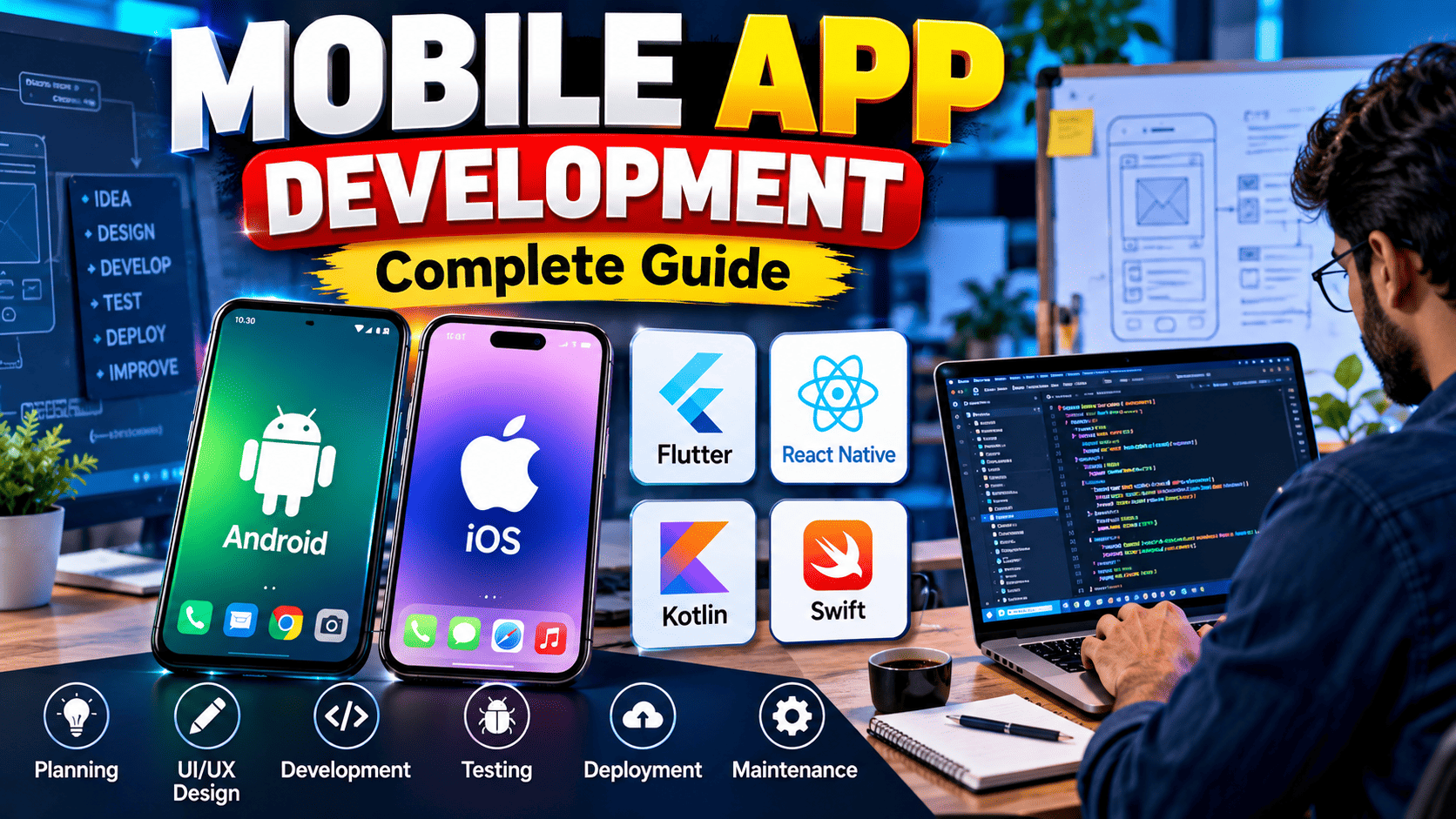
Native Android development commonly uses Kotlin and Android development tools, while native iOS development commonly uses Swift and Apple’s development ecosystem. Developers can also choose cross-platform frameworks such as Flutter or React Native when they want to share code across multiple platforms.
The right approach depends on the application’s requirements, development team, performance expectations, budget, device features, and long-term maintenance strategy.
Why Is Mobile App Development Important?
Smartphones have become a primary way for people to access digital services. Businesses therefore use mobile applications to provide convenient services, communicate with customers, process transactions, and build digital products.
A well-designed mobile application can provide faster access to services than a traditional website and can take advantage of device capabilities such as cameras, GPS, biometric authentication, notifications, sensors, and offline storage.
For developers, mobile application development also provides opportunities to work with modern technologies including cloud services, artificial intelligence, APIs, databases, cybersecurity, and real-time communication.
Types of Mobile App Development
1. Native App Development
Native development means building an application specifically for one operating system. Android applications can be developed using Kotlin and Android’s native tools, while iOS applications can be developed using Swift and Apple’s development environment.
The major advantage of native development is direct access to platform-specific APIs and capabilities. Native applications can be an excellent choice when an application requires high performance, advanced hardware integration, sophisticated graphics, or platform-specific functionality.
2. Cross-Platform App Development
Cross-platform development allows developers to build applications for multiple operating systems from a shared codebase. Flutter and React Native are two popular technologies used for this approach.
Cross-platform development can reduce duplicated development work and make it easier for teams to maintain common application logic. However, it is not automatically the best choice for every project. Applications requiring deep platform integration or specialized performance may still benefit from native development.
Flutter officially supports building applications for iOS and Android from a shared codebase, while React Native allows developers to create native applications for Android and iOS using React and JavaScript.
Popular Mobile App Development Technologies
Flutter
Flutter is an open-source framework that allows developers to build applications for multiple platforms from a single codebase. It uses the Dart programming language and provides a widget-based approach for creating user interfaces.
Flutter can be useful when a development team wants consistent UI behavior across platforms and wants to maintain a shared application codebase. Its hot reload capability also helps developers quickly experiment with interface and code changes.
React Native
React Native is a framework based on React that enables developers to create native mobile applications using JavaScript and React concepts. It provides platform-independent components that map to native user-interface elements.
React Native can be particularly attractive for teams that already have experience with JavaScript, TypeScript, or React-based web development.
Native Android Development
Native Android development is suitable for developers who want direct access to Android platform capabilities. Kotlin is Google’s recommended language for leveraging modern and unique Android capabilities.
Native Android development can be a strong choice for applications that need deep integration with Android APIs, specialized hardware, background services, or the latest platform functionality.
Native iOS Development
iOS applications are commonly developed using Swift and Apple’s development tools. Native iOS development provides access to Apple’s platform APIs and capabilities and is useful when an application needs close integration with the Apple ecosystem.
Mobile App Development Process
1. Define the App Idea
The first step is to clearly define the problem the application will solve. Developers and product teams should identify the target users, core features, business objectives, and expected user experience.
A common mistake is trying to build too many features in the first version. A better strategy is to identify the minimum viable product and prioritize the features that provide the most value.
2. Research and Requirements
Before development begins, the team should document functional and technical requirements. These may include user authentication, payments, notifications, search, location services, database requirements, APIs, analytics, and administrative functionality.
3. UI and UX Design
User interface and user experience are critical components of mobile application development. The interface should be simple, responsive, accessible, and consistent.
Developers should consider different screen sizes, touch interactions, navigation patterns, loading states, error messages, and accessibility requirements before implementation begins.
4. Select the Technology Stack
The development team should choose between native and cross-platform development based on project requirements rather than popularity alone.
For example, a standard business application targeting both Android and iOS may be a good candidate for Flutter or React Native. On the other hand, an application requiring intensive hardware integration or specialized platform features may benefit from native development.
5. Backend and API Development
Many mobile applications require backend services to manage authentication, user profiles, databases, payments, content, notifications, and other business operations.
APIs provide communication between the mobile application and backend services. A properly designed API architecture can make an application easier to maintain and scale.
Developers should also consider API authentication, authorization, rate limiting, error handling, logging, and secure data transmission.
6. Database Integration
Mobile applications may use local storage, cloud databases, or a combination of both. The appropriate database depends on the application’s requirements.
Developers should carefully design data models and consider synchronization, caching, offline access, data validation, and privacy before connecting the mobile application to production databases.
Mobile App Security Best Practices
Security should not be treated as a final step. It should be considered throughout the entire mobile app development lifecycle.
Applications should use encrypted communication, secure authentication, appropriate authorization, safe storage practices, input validation, and secure API communication. Sensitive information such as passwords, authentication tokens, and private user data should not be stored carelessly on a device.
Developers should also keep third-party libraries and development dependencies updated and regularly review application permissions.
Mobile App Testing
Testing is essential because mobile applications run across different devices, operating-system versions, screen sizes, network conditions, and hardware configurations.
Important testing approaches include unit testing, integration testing, UI testing, performance testing, security testing, usability testing, and regression testing.
Developers should test both normal and unexpected user behavior. For example, an application should be tested when the internet connection disappears, the user enters invalid information, the device has limited storage, or the application is moved between foreground and background states.
Mobile App Performance Optimization
Performance directly affects user experience. Slow startup times, excessive battery usage, memory problems, large application sizes, and unresponsive interfaces can negatively affect an application’s quality.
Developers can improve performance by optimizing images, reducing unnecessary network requests, caching appropriate data, avoiding inefficient operations, monitoring memory usage, and minimizing unnecessary background processing.
Performance should be measured on real devices rather than relying only on development environments or high-end hardware.
Mobile App Development and Artificial Intelligence
Artificial intelligence is becoming increasingly relevant to mobile application development. Developers can integrate AI-powered features such as text summarization, recommendations, image analysis, conversational interfaces, personalization, and intelligent search.
However, adding AI simply because it is popular is not a good product strategy. AI should solve a genuine user problem and should be evaluated for accuracy, privacy, latency, operating cost, and reliability.
On-device AI can also be useful for certain applications because processing information locally may reduce network dependency and improve privacy. The appropriate approach depends on the feature, device capabilities, model requirements, and application architecture.
Mobile App Development Cost Factors
There is no single fixed price for developing a mobile application. The cost depends on the complexity of the product, number of platforms, UI requirements, backend architecture, third-party integrations, security requirements, testing, maintenance, and development team.
A simple application with a few screens can be significantly less complex than an e-commerce platform, banking application, social network, or real-time communication system.
Cross-platform development may reduce duplicated development work, but it does not eliminate costs associated with design, backend services, testing, security, deployment, and maintenance.
How to Choose the Right Mobile App Development Approach
Choosing a technology should begin with the product requirements rather than a framework trend.
- Choose native development when deep platform integration is important.
- Consider Flutter when a shared codebase and consistent custom UI are priorities.
- Consider React Native when the team has strong React or JavaScript experience.
- Evaluate backend requirements before selecting the complete technology stack.
- Consider security, testing, scalability, and long-term maintenance from the beginning.
For beginners, learning programming fundamentals, data structures, object-oriented programming, APIs, databases, and software engineering concepts can provide a stronger foundation than immediately jumping into a framework.
Best Practices for Successful Mobile App Development
A successful mobile application is not simply an application that works. It should be reliable, secure, fast, understandable, and maintainable.
- Start with clearly defined user requirements.
- Keep the first version focused on essential functionality.
- Design the user experience before writing large amounts of code.
- Use version control and a structured development workflow.
- Build automated tests wherever practical.
- Monitor application performance after release.
- Protect user data and follow appropriate privacy practices.
- Keep dependencies and development tools updated.
- Collect useful feedback and improve the application continuously.
Future of Mobile App Development
The future of mobile app development is moving toward more intelligent, connected, secure, and adaptive applications. Cross-platform development continues to mature, while native development remains important for applications that require deep platform capabilities.
Artificial intelligence, on-device processing, cloud services, advanced authentication, wearable devices, and improved development automation are influencing how mobile applications are designed and maintained.
However, developers should avoid chasing every new technology. The strongest applications will continue to focus on solving real problems while using new technologies where they provide measurable benefits.
Conclusion
Mobile app development combines programming, design, backend engineering, databases, APIs, security, testing, deployment, and continuous maintenance. Developers can choose native technologies such as Kotlin and Swift or cross-platform solutions such as Flutter and React Native depending on the project’s requirements.
The most important decision is not simply choosing the most popular framework. Developers should evaluate performance, platform requirements, development resources, security, scalability, user experience, and long-term maintenance before starting development.
Whether you are a beginner learning app development or a business planning a new mobile product, a structured development process can reduce technical problems and improve the chances of building a reliable application. Start with a clear problem, build the essential features first, test thoroughly, protect user data, and continuously improve the product based on real user needs.