Introduction
Banker’s Algorithm is one of the most important deadlock avoidance algorithms used in operating systems. It was introduced by Edsger W. Dijkstra to help the operating system allocate resources safely among multiple processes. Before granting a resource request, the algorithm checks whether the system will remain in a safe state. If the allocation can cause a deadlock, the request is denied. Because of its importance, Banker’s Algorithm is frequently asked in computer science exams, GATE, university exams, and software engineering interviews.
What is Banker’s Algorithm?
Banker’s Algorithm is a deadlock avoidance technique that allows the operating system to decide whether a process should receive requested resources. The algorithm works similarly to a banker who carefully lends money only if enough funds remain to satisfy all customers. In the same way, the operating system allocates resources only when it is sure that every process can finish successfully without causing a deadlock.
Why is Banker’s Algorithm Used?
The main purpose of Banker’s Algorithm is to prevent deadlocks before they occur. Instead of recovering from a deadlock, the algorithm checks every resource request in advance and grants permission only if the system remains safe. This approach improves system reliability and prevents resource conflicts.
Important Terms
Available: Resources currently available in the system.
Maximum: Maximum resources required by each process.
Allocation: Resources currently allocated to a process.
Need: Remaining resources required to complete execution.
Safe State: A condition where every process can finish successfully.
Need Formula
Need = Maximum – Allocation
Steps of Banker’s Algorithm
Step 1: Read Available, Maximum, and Allocation matrices.
Step 2: Calculate the Need matrix using Need = Maximum − Allocation.
Step 3: Find a process whose Need is less than or equal to Available.
Step 4: Execute the process and release its allocated resources.
Step 5: Repeat until every process finishes.
Step 6: If all processes complete successfully, the system is in a safe state.
Banker’s Algorithm Solved Example
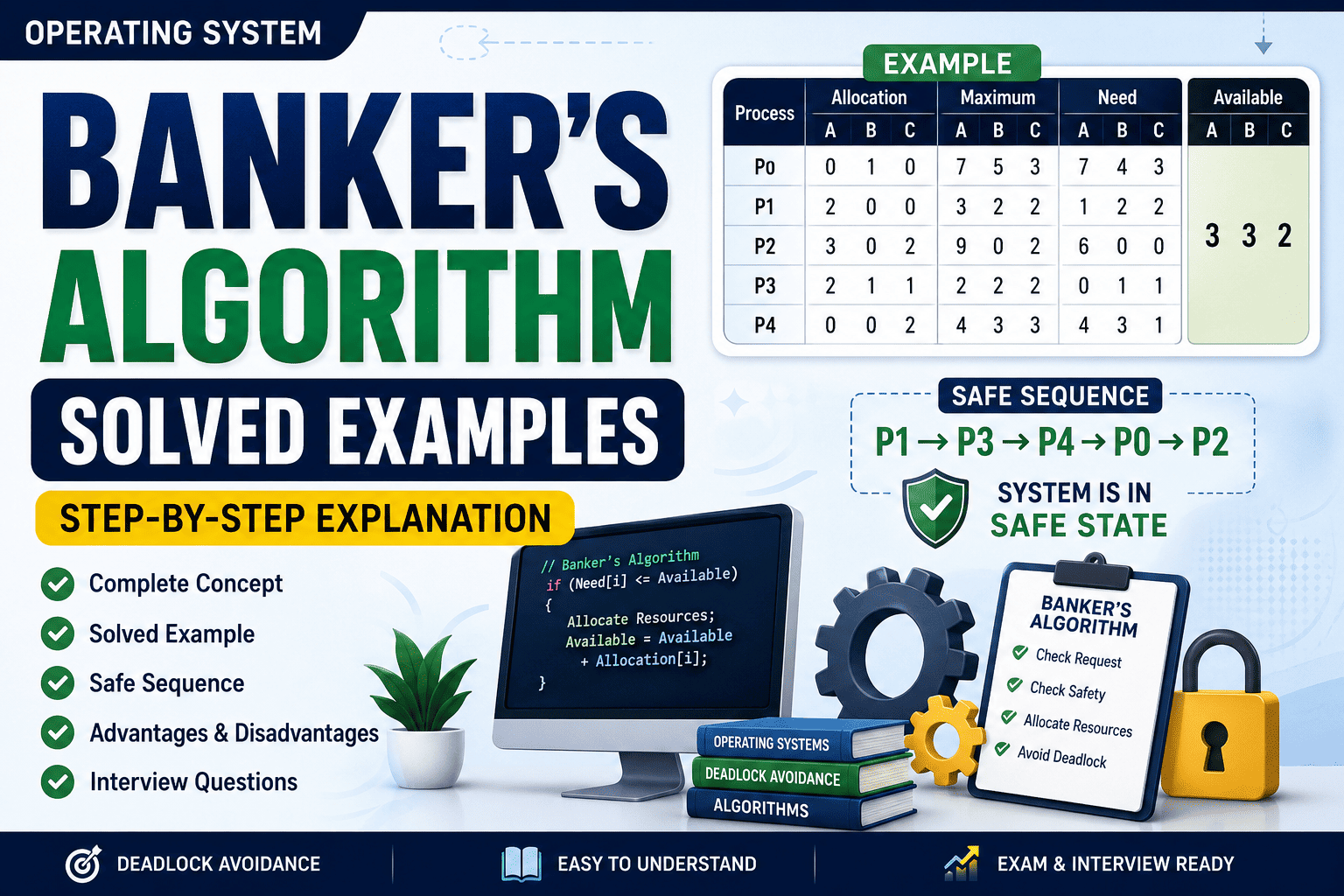
Consider five processes P0, P1, P2, P3, and P4 with three resource types A, B, and C.
Available Resources: A = 3, B = 3, C = 2
Allocation Matrix
P0 = 0 1 0
P1 = 2 0 0
P2 = 3 0 2
P3 = 2 1 1
P4 = 0 0 2
Maximum Matrix
P0 = 7 5 3
P1 = 3 2 2
P2 = 9 0 2
P3 = 2 2 2
P4 = 4 3 3
Need Matrix
P0 = 7 4 3
P1 = 1 2 2
P2 = 6 0 0
P3 = 0 1 1
P4 = 4 3 1
Finding the Safe Sequence
Initially Available = (3,3,2).
P1 can execute because its need is less than the available resources.
After P1 completes, Available becomes (5,3,2).
P3 now executes successfully.
Available becomes (7,4,3).
P4 executes next.
Available becomes (7,4,5).
P0 now completes successfully.
Finally, P2 also finishes execution.
Safe Sequence: P1 → P3 → P4 → P0 → P2
Since every process completes successfully, the system is in a safe state.
Advantages of Banker’s Algorithm
- Prevents deadlocks before they occur.
- Improves system stability.
- Efficient resource allocation.
- Frequently used for learning operating system concepts.
- Important for GATE and placement interviews.
Disadvantages of Banker’s Algorithm
- Requires maximum resource information in advance.
- High computational overhead.
- Not suitable for dynamic systems.
- Difficult to implement in very large systems.
Interview Questions
- What is Banker’s Algorithm?
- Why is Banker’s Algorithm called a deadlock avoidance algorithm?
- What is a safe state?
- How is the Need matrix calculated?
- What is the difference between deadlock prevention and deadlock avoidance?
- Why is Banker’s Algorithm important in operating systems?
Frequently Asked Questions (FAQs)
What is Banker’s Algorithm?
Banker’s Algorithm is a deadlock avoidance algorithm that allocates resources only when the system remains in a safe state.
Who developed Banker’s Algorithm?
The algorithm was developed by Edsger W. Dijkstra.
Where is Banker’s Algorithm used?
It is mainly studied in operating systems, GATE preparation, university exams, and technical interviews.
What is the Need matrix?
The Need matrix represents the remaining resources required by each process and is calculated using Need = Maximum − Allocation.
Conclusion
Banker’s Algorithm is one of the most important operating system algorithms for preventing deadlocks. By checking whether resource allocation keeps the system in a safe state, it ensures that all processes can complete successfully. Understanding the Need matrix, Available resources, Allocation matrix, Maximum matrix, and safe sequence is essential for exams and interviews. Practicing multiple banker’s algorithm solved examples will strengthen your understanding and improve your problem-solving skills.