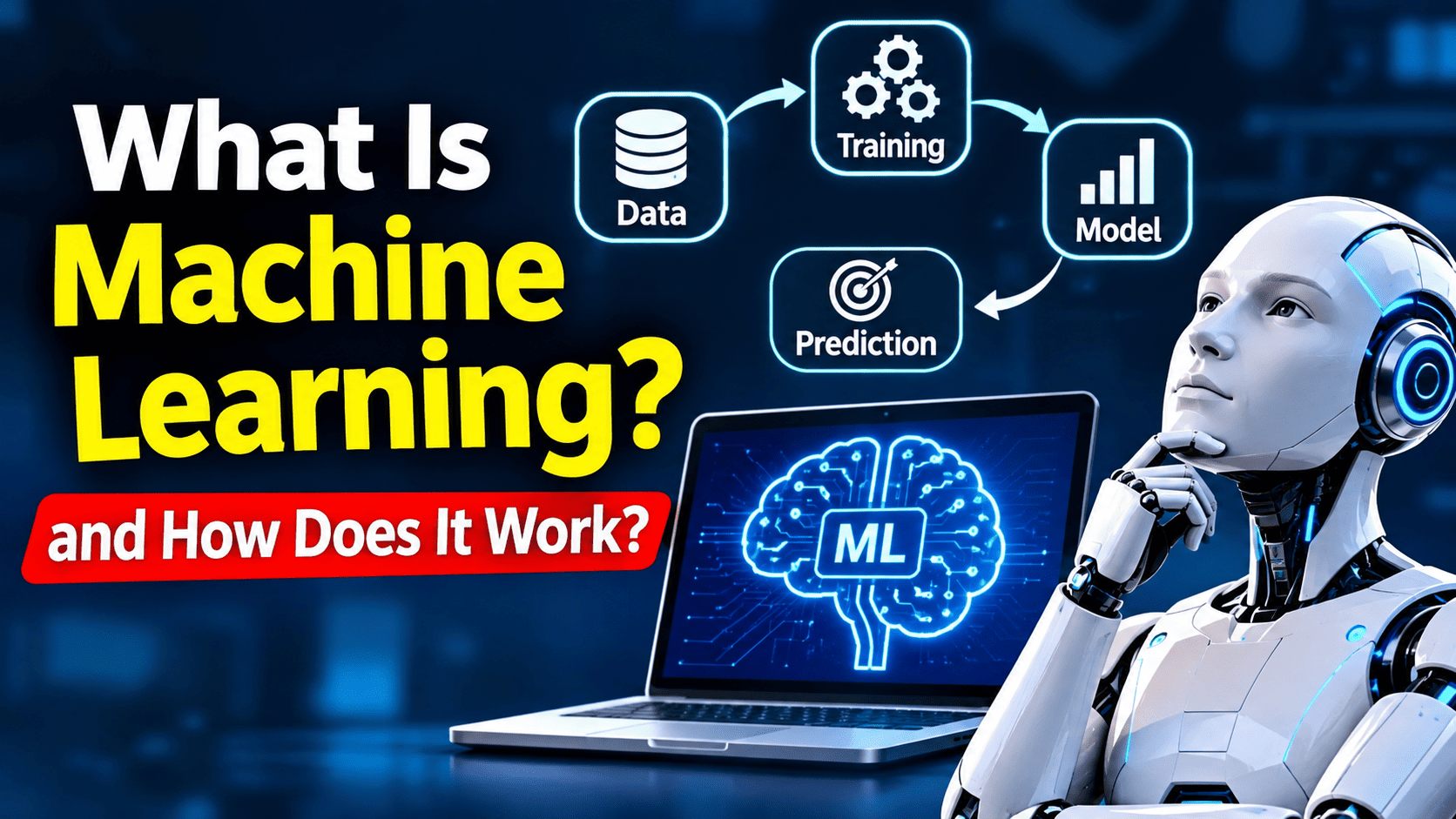
Instead of writing a separate rule for every possible case, developers provide data and choose a learning method. The algorithm uses the examples to build a model. That model can then make predictions on information it has not seen before. This guide explains what machine learning is, how it works, its main types, real-world applications, advantages, limitations, and how beginners can start learning it.
What Is Machine Learning?
Machine learning (ML) is a branch of artificial intelligence (AI) that allows computer systems to learn patterns from data and use them to make predictions or produce useful outputs. In traditional programming, developers write explicit rules. In machine learning, they provide examples and a learning algorithm adjusts the model during training.
Think about spam detection. A simple rule-based email filter might block messages containing certain words. Spammers can easily change those words. A machine learning model can study examples of spam and legitimate email, learning patterns involving phrases, senders, links, and message structure. When a new email arrives, it estimates which category is more likely.
A model does not understand the world like a human; it learns statistical relationships from examples. Google’s machine learning introduction explains the concept with examples.
How Does Machine Learning Work?
A typical machine learning project follows a cycle: define a problem, collect and prepare data, train a model, evaluate it, and monitor it after launch. The exact details depend on the task, but these stages provide a useful overview.
1. Define the Problem
Decide what the system needs to predict or identify. It could estimate house prices, classify product reviews, detect suspicious payments, or forecast sales. A clear goal helps determine which data and evaluation measures are relevant.
2. Collect and Prepare Data
Data may come from spreadsheets, databases, sensors, images, or text. It can contain missing values, duplicates, and errors, so it must be checked and cleaned. Developers may also select useful features—the input characteristics that help a model make a prediction.
3. Train the Model
During training, an algorithm processes examples and adjusts the model’s parameters to reduce prediction errors. For example, a house-price model might learn from past sales using location, floor area, and number of bedrooms. The algorithm is the learning procedure; the model is what it produces.
4. Test and Evaluate
The model should be tested on data that was not used during training. This helps show whether it has learned general patterns or simply memorized examples. Accuracy, precision, recall, and error measurements are among the metrics used, depending on the task.
5. Deploy and Monitor
A tested model can be added to an app, website, or business process. Teams should continue checking its performance because real-world data can change. Monitoring also helps identify errors, bias, privacy concerns, and the need for updates.
Main Types of Machine Learning
Machine learning methods are often grouped by the kind of feedback they receive. Three widely used categories are supervised, unsupervised, and reinforcement learning.
Supervised Learning
Supervised learning uses labelled examples, where each training input has a known answer. The model learns to predict that answer for new data. Classification predicts a category, such as spam or not spam. Regression predicts a number, such as a house price or delivery time.
Unsupervised Learning
Unsupervised learning uses data without supplied answers. It searches for structure, similarities, or unusual patterns. A retailer might group customers by purchasing behaviour, while an analyst might look for transactions that differ from normal activity. People still need to interpret whether the discovered patterns are useful.
Reinforcement Learning
In reinforcement learning, an agent takes actions in an environment and receives rewards or penalties. It learns a strategy that aims to maximize long-term reward. This approach is used in areas such as robotics, game-playing, and automated decision-making research.
Real-World Applications of Machine Learning
Machine learning is valuable when patterns are difficult to describe using fixed rules. Recommendation systems rank films, music, and products based on user activity. Banks can flag transactions for further review. Transport services estimate arrival times using traffic information, while manufacturers analyze equipment data to identify possible signs of failure.
Businesses use ML to forecast demand and manage inventory. Language technologies use it for translation, speech recognition, search, and text classification. In healthcare, researchers study medical images and clinical data with ML tools, but model outputs must be assessed by qualified professionals and should not replace clinical judgement.
Generative AI is one part of machine learning. It uses learned patterns to create text, images, audio, or other content, while ML also supports prediction, classification, and clustering.
Machine Learning vs. Artificial Intelligence vs. Deep Learning
Artificial intelligence is the broad field of creating systems that perform tasks associated with aspects of human intelligence. Machine learning is one approach within AI: systems learn patterns from data instead of relying only on hand-written rules. Deep learning is a subfield of ML that uses neural networks with multiple layers to learn complex patterns.
An AI application may combine software rules with ML, while a deep learning model inside it recognizes objects in photographs. The right method depends on the problem and available data. See Google Cloud’s machine learning guide.
Benefits and Limitations of Machine Learning
ML can analyze large datasets, find patterns, automate predictions, and personalize digital services. It supports faster decisions when the model and task are well defined.
ML is not automatically reliable. Poor data can produce weak predictions, and models may repeat historical bias. Complex systems can be hard to explain and costly to train. A prediction is not a guarantee, and correlation does not prove cause and effect. Privacy, fairness, security, and human oversight matter from the start.
How to Start Learning Machine Learning
Start with Python, then learn averages, graphs, probability, and basic statistics. Practise with datasets, understand training and test data, and study classification and regression before advanced models.
Use the scikit-learn guide for practical tools and Google’s free Machine Learning Crash Course for lessons and exercises. Build a small project, such as classifying movie reviews, and document the results.
Continue with related tutorials on Python programming for beginners, machine learning algorithms explained, and machine learning projects for beginners. Replace these sample paths with matching published pages on your website. These are internal-link placeholders, not live links.
Frequently Asked Questions
Is Machine Learning Difficult for Beginners?
It combines coding, data, and statistics. Start with Python basics and small projects before advanced topics.
Do I Need Coding to Learn Machine Learning?
You can learn the concepts without coding, but practical ML usually involves programming. Python is a popular starting language.
Is Machine Learning the Same as Generative AI?
No. Generative AI creates new content and often uses machine learning, but ML also includes prediction, classification, clustering, and other tasks.
Conclusion
Machine learning enables computers to learn patterns from data and apply them to new situations. Its workflow includes defining a problem, preparing data, training and evaluating a model, and monitoring performance after deployment. Supervised, unsupervised, and reinforcement learning address different problems, while deep learning and generative AI extend the field. To learn ML effectively, build a strong foundation and practise with small, carefully evaluated projects. Focus on solving real problems rather than simply collecting tools.
“`