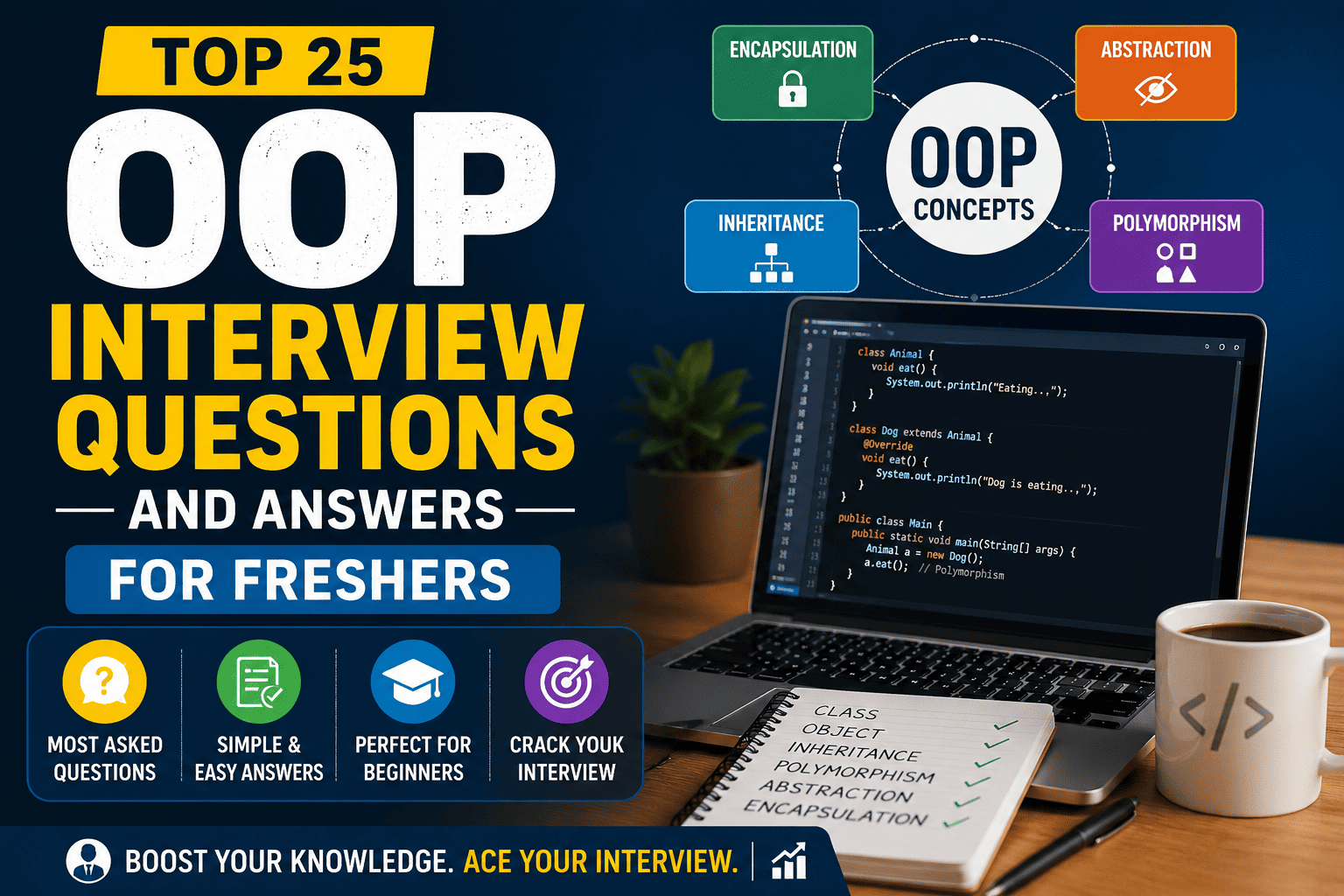
If you are preparing for a software developer interview, learning OOP interview questions is one of the smartest ways to improve your chances of getting selected. Object-Oriented Programming (OOP) is a core programming concept used in Java, C++, Python, C#, PHP, and many other languages. Almost every technical interview includes questions related to OOP because it helps interviewers evaluate your understanding of software design, problem-solving, and coding principles. This guide covers the most frequently asked OOP interview questions with simple and easy-to-understand answers that are ideal for freshers and beginners.
Object-Oriented Programming is a programming paradigm that organizes code into objects instead of functions alone. Each object contains data and methods that work together. This approach improves code readability, maintainability, and reusability. Modern software applications, enterprise systems, mobile apps, and web platforms are all built using OOP concepts because they simplify large projects and reduce code duplication. Understanding these fundamentals will make it easier to answer interview questions confidently.
What is Object-Oriented Programming (OOP)?
Object-Oriented Programming is a programming methodology where software is built around objects. An object represents a real-world entity that contains properties (data) and behaviors (methods). Instead of writing repetitive code, developers create reusable objects that interact with one another. OOP improves scalability, modularity, and code organization, making development faster and more efficient.
What are the four pillars of OOP?
The four fundamental principles of Object-Oriented Programming are Encapsulation, Abstraction, Inheritance, and Polymorphism.
Encapsulation means wrapping data and methods into a single unit while restricting direct access to internal data. This improves security and prevents accidental modifications.
Abstraction hides unnecessary implementation details and exposes only essential features. It allows developers to focus on what an object does rather than how it works internally.
Inheritance enables one class to acquire the properties and methods of another class. It promotes code reuse and reduces duplication.
Polymorphism allows a single interface to perform different tasks depending on the object. The same method can behave differently for different classes.
What is a Class?
A class is a blueprint used to create objects. It defines the properties and behaviors that objects will have. For example, a Car class may contain properties such as color, model, and speed along with methods like start() and stop().
What is an Object?
An object is an instance of a class. Once a class is defined, multiple objects can be created using that class. Every object has its own unique data while sharing the same structure defined by the class.
Difference Between Class and Object
A class is only a template, whereas an object is the actual implementation of that template. A class occupies no memory until objects are created, while every object occupies memory during program execution.
What is Inheritance?
Inheritance allows one class to inherit properties and methods from another class. The existing class is known as the parent or base class, while the new class is called the child or derived class. This reduces code duplication and improves maintainability.
What is Polymorphism?
Polymorphism means “many forms.” It enables the same method name to perform different actions depending on the object that calls it. Compile-time polymorphism is achieved through method overloading, while runtime polymorphism is achieved using method overriding.
What is Encapsulation?
Encapsulation is the process of combining variables and methods into a single class while restricting direct access to internal data. Developers typically use private variables and public getter/setter methods to implement encapsulation.
What is Abstraction?
Abstraction focuses only on the essential details while hiding complex implementation. In Java, abstraction can be implemented using abstract classes and interfaces. It helps developers create flexible and maintainable applications.
Difference Between Abstraction and Encapsulation
Abstraction hides implementation complexity from users, whereas encapsulation protects data by restricting access. Abstraction answers “what” an object does, while encapsulation focuses on “how” data is protected.
What is Method Overloading?
Method overloading allows multiple methods to have the same name but different parameter lists. It is an example of compile-time polymorphism because the compiler determines which method should be executed.
What is Method Overriding?
Method overriding occurs when a child class provides its own implementation of a method already defined in the parent class. It enables runtime polymorphism and dynamic method dispatch.
What is a Constructor?
A constructor is a special method that is automatically executed when an object is created. It initializes object data and prepares the object for use. Constructors have the same name as the class and do not return any value.
What is a Destructor?
A destructor is used to release resources when an object is destroyed. Languages like C++ support destructors explicitly, while Java relies on automatic garbage collection.
What is an Interface?
An interface defines a contract that classes must implement. It contains method declarations without implementation, allowing multiple classes to provide their own versions of those methods. Interfaces promote flexibility and loose coupling.
What is an Abstract Class?
An abstract class is a partially implemented class that cannot be instantiated directly. It may contain both abstract methods and fully implemented methods. Child classes extend abstract classes and provide implementations for abstract methods.
Difference Between Interface and Abstract Class
An interface mainly defines behavior, whereas an abstract class can define both behavior and implementation. Interfaces support multiple inheritance, while abstract classes support single inheritance in languages like Java.
What is Dynamic Binding?
Dynamic binding means the method to be executed is determined during runtime rather than compile time. It plays an important role in runtime polymorphism.
What is Static Binding?
Static binding occurs when the method call is resolved during compilation. Static methods, private methods, and final methods are examples of static binding.
Why is OOP Important?
Object-Oriented Programming simplifies software development by encouraging reusable, secure, and modular code. It makes applications easier to maintain and extend as business requirements change. OOP is widely used in enterprise software, Android development, game development, desktop applications, and web development.
Tips to Crack OOP Interview Questions
Before attending an interview, understand all four OOP principles thoroughly. Practice coding examples using Java, C++, or Python instead of memorizing definitions. Learn the differences between interfaces, abstract classes, constructors, overloading, and overriding because these are frequently asked topics. Solve coding problems that involve inheritance and polymorphism to strengthen practical knowledge. Finally, explain every concept with simple real-world examples during the interview, as interviewers often value clear understanding over memorized definitions.
Conclusion
Mastering OOP interview questions is essential for freshers aiming to build a successful career in software development. Since Object-Oriented Programming forms the foundation of modern programming languages, interviewers consistently test these concepts during technical rounds. By understanding classes, objects, inheritance, encapsulation, abstraction, polymorphism, constructors, interfaces, and abstract classes, you can confidently answer both theoretical and practical questions. Regular practice combined with coding examples will improve your confidence and significantly increase your chances of clearing programming interviews.