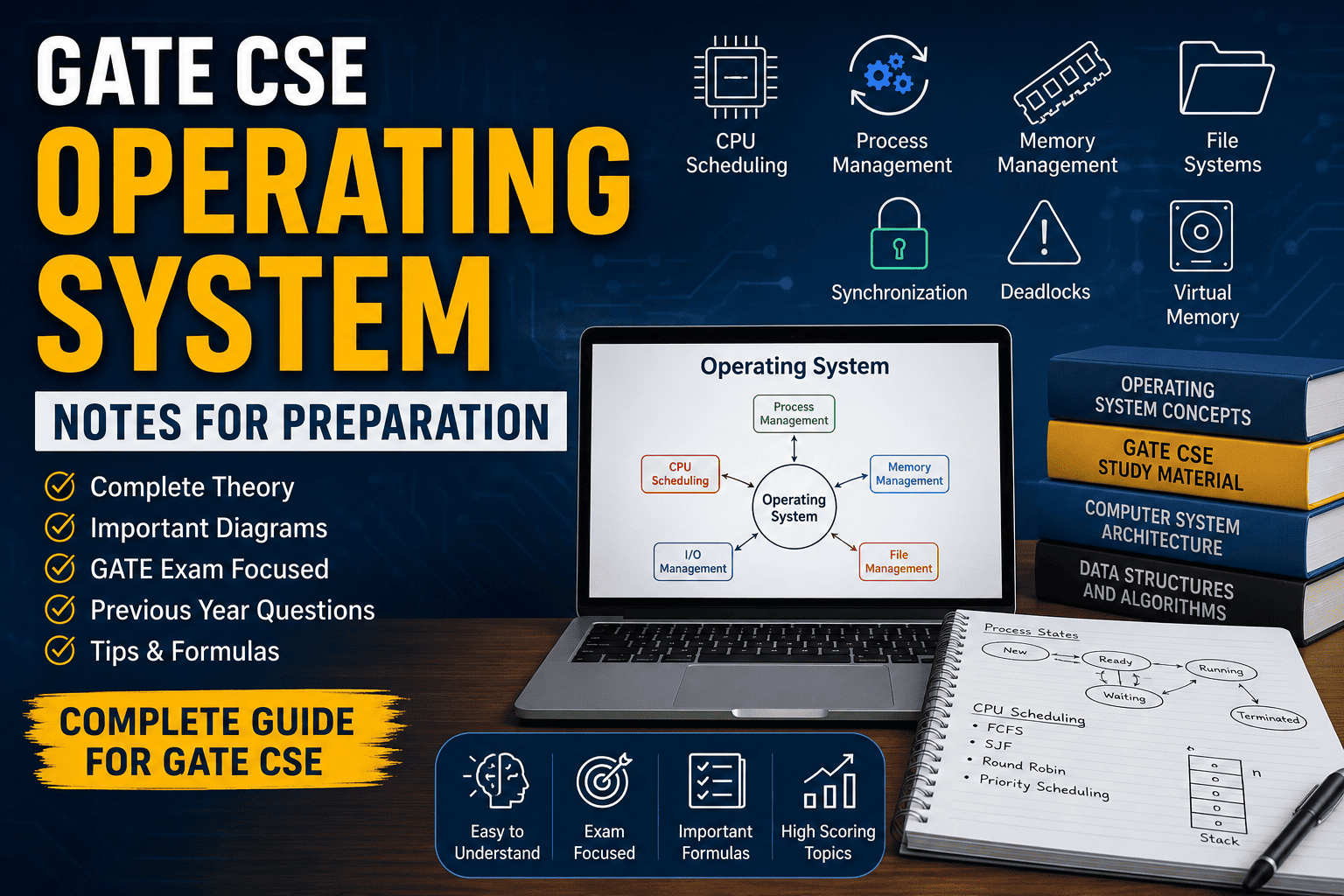
Preparing for GATE CSE can feel overwhelming because the syllabus is vast and highly competitive. Among all subjects, Operating System (OS) is one of the most important topics that frequently appears in the exam. Every year, several questions are asked from process management, CPU scheduling, deadlocks, memory management, virtual memory, and file systems. A strong understanding of Operating System concepts can significantly improve your GATE score.
Operating System acts as an interface between computer hardware and users. It manages system resources efficiently and ensures that multiple programs can run smoothly. For GATE CSE aspirants, mastering Operating System is essential because it is both a theoretical and numerical subject. Questions often test conceptual understanding along with problem-solving ability.
What is an Operating System?
An Operating System is system software that manages hardware resources and provides services to application programs. It controls memory, CPU, storage devices, and input-output operations. Popular examples include Windows, Linux, macOS, and Android.
The main objectives of an Operating System are resource management, process management, security, and efficient utilization of hardware components.
For a complete understanding of computer fundamentals, you can also read our Computer Networks Notes for GATE CSE (Internal Link).
Process and Process States
A process is a program in execution. It consists of code, data, program counter, stack, and allocated resources.
The five basic process states are:
- New
- Ready
- Running
- Waiting
- Terminated
Questions related to process state transitions are commonly asked in GATE examinations. Students should understand how a process moves between ready, running, and waiting states.
The Process Control Block (PCB) stores information about a process such as process ID, register values, scheduling information, and memory allocation details.
CPU Scheduling
CPU scheduling is one of the highest-weightage topics in Operating System.
The scheduler decides which process should get CPU time. Important scheduling algorithms include:
First Come First Serve (FCFS)
Processes are executed in the order they arrive. It is simple but may lead to the convoy effect.
Shortest Job First (SJF)
The process with the smallest burst time gets executed first. It minimizes average waiting time.
Round Robin (RR)
Each process receives a fixed time quantum. It is widely used in time-sharing systems.
Priority Scheduling
Processes are scheduled based on priority values.
Shortest Remaining Time First (SRTF)
It is the preemptive version of SJF and frequently appears in GATE numerical questions.
While preparing, focus on calculating:
- Waiting Time
- Turnaround Time
- Response Time
- Throughput
These formulas are frequently tested in GATE CSE.
Process Synchronization
When multiple processes access shared resources simultaneously, synchronization becomes necessary.
The critical section problem is a popular GATE topic.
Three conditions for a correct solution are:
- Mutual Exclusion
- Progress
- Bounded Waiting
Common synchronization tools include:
- Semaphore
- Mutex
- Monitor
A semaphore is an integer variable used to control access to shared resources.
There are two types:
- Binary Semaphore
- Counting Semaphore
Understanding semaphore operations P() and V() is crucial for solving GATE questions.
Deadlocks
Deadlock occurs when a group of processes waits indefinitely for resources held by one another.
The four necessary conditions for deadlock are:
- Mutual Exclusion
- Hold and Wait
- No Preemption
- Circular Wait
If all four conditions exist simultaneously, a deadlock can occur.
Deadlock handling techniques include:
- Deadlock Prevention
- Deadlock Avoidance
- Deadlock Detection
- Deadlock Recovery
Banker’s Algorithm is one of the most important deadlock avoidance algorithms and is frequently asked in GATE examinations.
Students should practice numerical problems based on resource allocation matrices and safe sequences.
Memory Management
Memory Management is another high-scoring topic in Operating System.
The operating system manages primary memory and allocates space to processes.
Key concepts include:
Contiguous Memory Allocation
Memory is allocated in continuous blocks.
Paging
Paging divides memory into fixed-size pages and frames.
Important Formula:
Number of Pages = Process Size / Page Size
Questions involving logical address calculation and page tables are commonly asked.
Segmentation
Segmentation divides memory into logical segments such as code, stack, and data.
Difference between Paging and Segmentation is a favorite GATE theory question.
Virtual Memory
Virtual Memory allows execution of processes even when physical memory is limited.
Advantages include:
- Efficient memory utilization
- Larger address space
- Better multitasking
Important concepts:
- Demand Paging
- Page Fault
- Thrashing
- Working Set Model
A page fault occurs when a required page is not present in main memory.
Students should practice page replacement algorithms thoroughly.
Page Replacement Algorithms
These algorithms decide which page should be removed when memory becomes full.
FIFO
First loaded page is removed first.
LRU
Least Recently Used page is replaced.
Optimal Page Replacement
Replaces the page that will not be used for the longest period in the future.
Among these, LRU and Optimal algorithms are frequently asked in GATE CSE.
File Systems
A file system organizes and manages files stored on secondary storage devices.
Functions include:
- File creation
- File deletion
- File organization
- Access control
Common file allocation methods:
Contiguous Allocation
Files occupy consecutive disk blocks.
Linked Allocation
Blocks are linked together using pointers.
Indexed Allocation
An index block stores addresses of all file blocks.
Questions comparing these allocation methods appear regularly in GATE examinations.
Disk Scheduling Algorithms
Disk scheduling improves the efficiency of disk access operations.
Important algorithms include:
- FCFS
- SSTF
- SCAN
- C-SCAN
- LOOK
- C-LOOK
Among these, SCAN and C-SCAN are the most frequently asked algorithms.
Students should solve numerical questions involving head movement calculations.
Important Operating System Formulas for GATE
CPU Utilization:
CPU Utilization = (CPU Busy Time / Total Time) × 100
Turnaround Time:
Turnaround Time = Completion Time − Arrival Time
Waiting Time:
Waiting Time = Turnaround Time − Burst Time
Effective Access Time:
EAT = (1 − p) × Memory Access Time + p × Page Fault Service Time
These formulas are commonly used in GATE numerical questions.
Preparation Strategy for GATE CSE Operating System
Start with process management and CPU scheduling because they form the foundation of Operating System concepts. After that, move to synchronization, deadlocks, memory management, and virtual memory. Finally, cover file systems and disk scheduling algorithms.
Solve previous year GATE questions after completing each topic. This approach helps identify weak areas and improves conceptual clarity. Make short notes containing formulas, algorithms, and important definitions for quick revision.
Attempt topic-wise mock tests regularly and analyze mistakes carefully. Consistent practice is more important than studying theory repeatedly.
For better preparation, also study DBMS Notes for GATE CSE, Computer Networks Notes for GATE CSE, and Data Structures Notes for GATE CSE to strengthen your overall score in the exam.
Conclusion
Operating System is one of the most important and scoring subjects in GATE CSE preparation. Topics such as CPU scheduling, process synchronization, deadlocks, memory management, paging, virtual memory, file systems, and disk scheduling appear regularly in the examination. A clear understanding of concepts combined with consistent problem-solving practice can help candidates secure excellent marks. Focus on understanding the logic behind algorithms rather than memorizing them, and regularly revise formulas and previous year questions to maximize your performance in GATE CSE.